

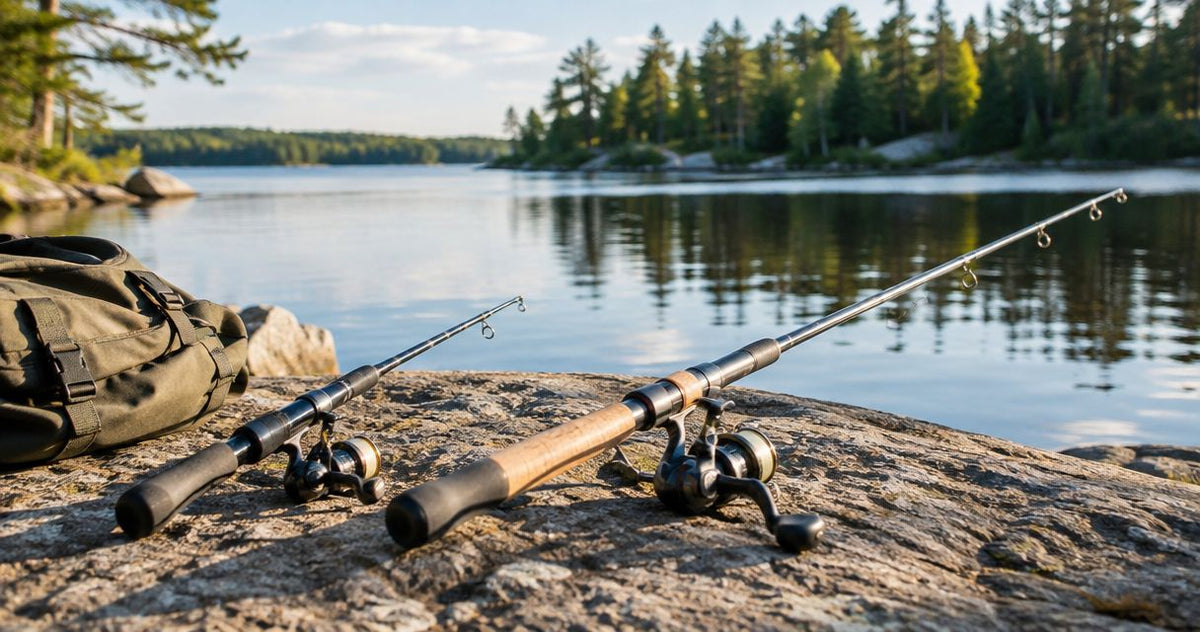
A compact fishing rod can be as good as a full-size rod when its assembled length, power, action, and lure rating suit the fishing you do. A travel rod that packs down is not the same as a rod that stays short: the first changes how you carry your gear, while the second also changes your reach and line control.
- Compact fishing rod vs full size rod: compare fishing length and ratings, not packed size alone.
- A travel rod is best for anglers who need packability without giving up their preferred fishing length.
- A short rod suits tight spaces but gives you less reach for managing line around obstacles.
- Crystalcreekgear hand reel fishing kits suit anglers who want a rodless option for spontaneous outings.
Why this matters
Small gear solves a carrying problem. It does not automatically solve every fishing problem. A rod that fits your bag still needs to handle your lure, your line, and the water in front of you.
For your 2026 gear choice, start with the trip rather than the word compact. Are you hiking to a pond, keeping fishing gear in a vehicle, or spending the day casting from an open bank? The compact fishing gear guide for van-life travelers addresses the carrying side of that decision.
Choose the fishing tool for the water, then choose how you want to carry it.
Is a compact fishing rod as good as a full-size rod?
Yes, if the compact rod matches the job. A multi-piece travel rod can assemble to a conventional fishing length, so a short packed size does not necessarily mean a short working rod. A genuinely short rod makes a different trade: easier handling in confined spaces, but less reach.
The useful comparison is not simply small versus big. Separate rods that pack down from rods that remain short, and keep rodless fishing in its own category.
| Option | Best for | Main advantage | Main limitation |
|---|---|---|---|
| Multi-piece travel rod | Anglers transporting a rod in a bag or vehicle | Packs into shorter sections while retaining its assembled fishing length | Requires assembly and correctly seated joints |
| Telescopic rod | Anglers who prefer collapsing sections | Sections retract rather than separating into loose pieces | Requires attention to section seating and cleanliness |
| Short fishing rod | Anglers working in confined casting spaces | Easier to move where a longer rod gets in the way | Less reach for steering line around bankside obstacles |
| Full-length conventional rod | Anglers whose transport allows their preferred rod length | Lets you choose length around casting and presentation needs | Its transport length can be inconvenient |
| Rodless hand reel | Anglers prioritizing a rod-free carry setup | Removes the rod from the equipment you carry | Does not provide a rod tip for casting or managing line |
None of these categories guarantees sensitivity, strength, or casting distance. Those depend on the actual equipment and how you use it. In 2026, judge the assembled rod, not the size of its storage case.
Multi-piece travel rods: best for familiar fishing with easier transport
A multi-piece travel rod is the closest answer to “full-size fishing, smaller luggage.” Its sections join into a working rod, and its packed length is shorter than its assembled length. That makes it a sensible starting point when transport is your main problem.
Compare the assembled length, power, action, and stated lure and line ratings with the rod you already like. Matching those characteristics gives you a more useful shortlist than choosing whatever has the smallest carrying case. Similar labels do not guarantee identical feel, so handling the assembled rod still matters.
The trade-off is setup and joint care. Seat each section according to the manufacturer's instructions, align the guides, and check the connections during use. Loose joints are not something to ignore because the rod feels convenient.
Best for: hikers and travelers who still want to fish with a rod and reel. Choose this category when you want to reduce transport length without deliberately reducing fishing length.
Telescopic rods: best for anglers who prefer collapsing sections
A telescopic rod reduces its packed length by retracting sections into one another. That is a different construction from a travel rod with separate pieces, even when both are sold as compact fishing rods. Compare their working dimensions before treating them as interchangeable.
The appeal is straightforward: you extend the rod to fish and collapse it to carry. The responsibility is straightforward, too. Follow the extension sequence, seat the sections as instructed, and keep grit away from the sliding surfaces.
Do not assume every telescopic rod feels the same or suits the same lure. Check the manufacturer's ratings and examine the extended rod rather than judging it only while collapsed. Guide alignment and section seating deserve attention before you make a cast.
Best for: anglers who specifically want retracting sections. Choose a telescopic rod for that packing method, not because the category name promises better fishing performance.
Short rods: best for confined spaces, not maximum reach
A short rod stays short while you fish. That can make handling easier where trees, structures, or your own position restrict movement. It also means you have less rod length available to lift line clear of an obstacle or steer it around the edge of a bank.
That trade matters more than the small packed dimensions. A convenient carry setup is no help if your usual fishing spot requires reaching over vegetation. Conversely, a longer rod becomes awkward when you cannot move it freely.
Check lure and line ratings just as carefully as you would on a longer rod. Short does not automatically mean light-duty, and long does not automatically mean strong. Rod power describes resistance to bending; action describes where the rod bends under load.
Best for: anglers whose fishing position rewards a shorter working rod. Choose this category because the space calls for it, not simply because you want less gear in your bag.
Full-length rods: best when the fishing job sets the length
A conventional rod makes sense when you can transport the working length you want without difficulty. You can then choose around presentation, reach, lure handling, and personal comfort rather than forcing everything into a small bag. Portability becomes a secondary concern.
The drawback is carrying that rod to the water. Brush, luggage, vehicle storage, and walking routes all affect how convenient it feels. A rod that is comfortable to fish with can still be awkward to bring along.
Full-length rods also need sensible selection. Extra length alone does not guarantee better accuracy, more sensitivity, or better fish control. Match the whole setup to the task, including the reel, line, and lure.
Best for: anglers who can carry their preferred working rod comfortably. Keep that setup when it already suits your water; portability is a reason to add another option, not proof that your existing rod is wrong.
Why compact fishing rod performance varies
For a compact fishing rod vs full size rod comparison in 2026, these are the differences that deserve your attention:
- Assembled length: working length affects reach and how you position line around obstacles. Packed length answers a separate transport question.
- Power and action: these describe different bending characteristics. Match both to your intended use rather than treating “compact” as a performance rating.
- Lure and line ratings: use the manufacturer's stated range when selecting tackle. A portable design does not remove those limits.
- Construction and connections: separate joints and telescoping sections require correct seating. Check the instructions for the rod you own.
- Casting space: overhead branches, nearby people, and bankside cover affect how freely you can move any rod.
- Reel and line setup: the rod is only part of the system. Line condition, reel setup, and lure choice affect casting and presentation too.
Portability is a feature; suitability is the decision. Keep those ideas separate and you will avoid expecting a small carrying package to tell you everything about fishing performance.
How do you choose between a compact and full-size rod?
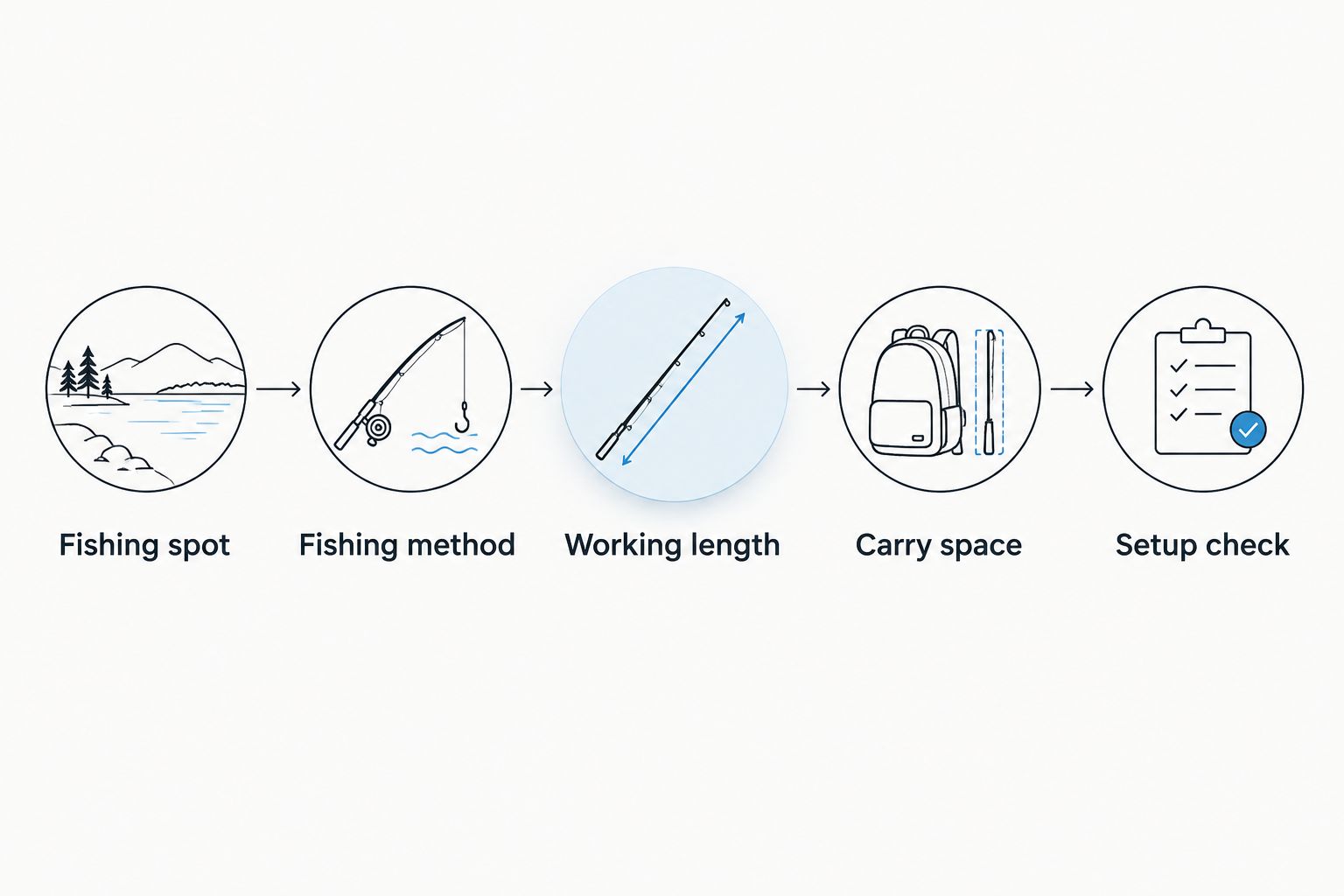
Use this sequence for your 2026 shortlist. It keeps the decision tied to the places you actually fish rather than a label on the packaging.
- Fishing spot: picture where you will stand and where your bait or lure needs to go. Identify nearby cover, your casting space, and any obstacle you need to keep line clear of.
- Fishing method: decide whether you want to cast and retrieve a lure, present bait, or use another method. Select rod ratings around that job.
- Working length: choose the reach and handling you need while fishing. Only then ask whether a travel design can pack that length more conveniently.
- Carry space: check the actual storage space you have. Compare packed dimensions with your bag or vehicle rather than relying on terms such as pocket or travel.
- Setup check: assemble or extend the rod, follow its instructions, and check guide alignment, connections, and tackle compatibility before fishing.
If you already own a rod you enjoy, use it as your reference. Write down its stated characteristics and decide what you want to change: the carrying length, the working length, or the fishing method itself. Changing all of those at once makes comparisons less useful.
You do not need one setup to win every situation. Keep the familiar rod for planned sessions and choose a compact alternative for trips where carrying it is the obstacle.
Can a compact fishing rod cast as far as a full-size rod?
A compact rod does not lose casting distance simply because it packs down. Compare assembled length, action, lure rating, reel setup, and line rather than treating packed size as the deciding factor.
A rod that remains short gives you a different casting tool from a travel rod that assembles to a longer length. Neither the word compact nor full-size provides a dependable distance figure. Without a matched comparison, a numerical casting claim would not help you choose.
For your 2026 decision, ask whether the rod places your lure where you need it—not whether its category sounds more powerful.
Can a compact fishing rod handle bigger fish?
A compact rod's packed size does not establish its fish-handling limit. Use its stated ratings and instructions, and consider the line, knots, reel drag, cover, and landing method as part of the setup.
Do not use a fish's weight as permission to lift it with the rod. Plan how you will land and support the catch before you start fishing, and avoid forcing the rod into a sharply bent position under load.
A portable rod deserves the same careful selection and handling as any other rod. If you expect demanding conditions, choose equipment with ratings that fit those conditions rather than relying on compactness or length as a strength claim.
Where does a rodless hand reel fit?
A hand reel belongs in this discussion because sometimes the real question is not which rod folds smaller. It is whether you want to carry a rod at all. That changes the fishing method, not just the storage arrangement.
Crystalcreekgear hand reel fishing kits are best for anglers who want a compact, rodless setup for spontaneous outings. The GoReel Rodless Hand Reel Fishing Kit - River is one option for that approach. It is a hand reel, not a compact rod.
The benefit is removing the rod from what you carry. The limitation is removing the rod tip from what you use: a hand reel does not provide the same casting mechanics or line-positioning tool as a rod-and-reel setup. Choose it because you want that simpler format, not because it duplicates every rod technique.
Crystalcreekgear serves anglers looking for portable gear for lakes, rivers, and ponds. Match a rodless setup to the outing, check local fishing rules, and learn safe line handling. Never wrap fishing line around your fingers or hands under tension.
FAQ
Is a compact fishing rod as good as a full-size rod?
A compact fishing rod can be as good for the same job when its assembled length, power, action, and ratings suit that job. A rod that packs down is different from one that stays short while fishing.
What's the best compact rod type for traveling?
A multi-piece travel rod is a sensible starting point when you want a familiar working length with shorter packed sections. Choose a telescopic design if you prefer retracting sections, and check the assembled characteristics of either type.
Does a shorter fishing rod mean less strength?
A shorter fishing rod does not automatically mean less strength. Check the manufacturer's power, line and lure ratings, and handling instructions rather than using length as a strength rating.
Is a telescopic fishing rod the same as a travel rod?
A telescopic rod retracts sections into one another, while a multi-piece travel rod separates into sections. Both reduce transport length, but their assembly and care requirements differ.
Should I replace my regular rod with a compact rod?
Keep your regular rod if it suits your fishing and you can carry it comfortably. Add a compact option when transport or limited space prevents you from bringing that setup.
Is a GoReel hand reel a compact fishing rod?
A GoReel hand reel is rodless, not a compact fishing rod. Crystalcreekgear offers this format for anglers seeking portable fishing gear, but it does not provide a rod tip for casting or managing line.
One last thing
The smallest package and the shortest fishing rod are not necessarily the same thing. That distinction is easy to miss—and it changes the whole comparison.
Before choosing your 2026 setup, write down the reason you leave fishing gear behind. If the problem is transport length, start with a pack-down rod. If the problem is restricted casting space, consider working length. If you want to ditch the rod altogether, explore hand reel fishing as a different method.
Solve the reason you are not bringing gear, without creating a new problem at the water. Less gear is useful when it still lets you fish the way you want.


