

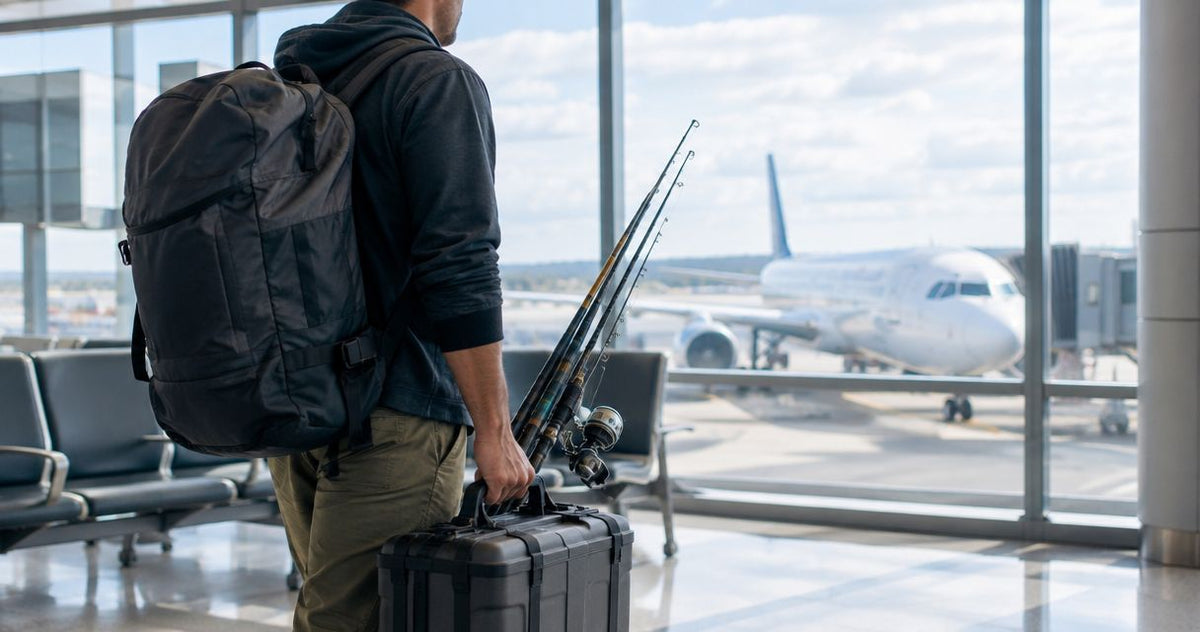
Yes, you can travel with a fishing kit on a plane in 2026, but you must sort its contents: ordinary reels and fishing line can generally go in carry-on luggage, while large hooks and restricted sharp tools belong in checked baggage. TSA makes the final screening decision at U.S. checkpoints, and your airline sets the baggage-size rules, so a pocket-sized kit is not automatic permission to carry every item inside it.
- You can travel with fishing kit on a plane; TSA rules apply to each item, not the kit's label.
- Carry ordinary reels and line; pack large fishing hooks and restricted blades in checked baggage.
- Crystal Creek Gear hand reel fishing kits suit compact packing, but their contents still need individual screening checks.
- Check airline baggage limits and destination fishing rules before packing your portable fishing gear.
Why this matters
A fishing kit is a collection of items, not a single security category. Your reel, hooks, scissors, bait, and multitool can each have a different packing rule. Sort the contents before you zip the bag.
For a 2026 fishing trip, separate three questions: what airport security permits, what your airline accepts, and what your destination allows. Passing a security checkpoint does not settle the other two.
If fishing is one part of a longer trip, the same keep-it-small approach applies to compact fishing gear for travelers. Pack for the water you actually plan to fish, rather than bringing every rig you own.
Can you travel with a fishing kit on a plane?
Yes. For U.S. departures, TSA permits fishing poles in carry-on and checked bags, subject to airline size limits, and advises travelers to pack sharp fishing tackle such as large hooks in checked luggage. TSA also recommends carrying expensive reels or fragile tackle that does not pose a security threat in your carry-on.
That distinction matters. A reel without exposed hooks is a different screening question from a ready-to-fish setup with a large lure attached. Remove the rig and assess the pieces separately.
Use this table as a packing guide, not a guarantee that an officer will accept a particular item.
| Item | Carry-on approach | Checked-bag approach | Main caution |
|---|---|---|---|
| Ordinary fishing reel or hand reel | Generally suitable if it presents no security threat | Also suitable | Separate attached hooks and sharp tackle |
| Fishing line | Generally suitable | Also suitable | Keep loose line contained |
| Fishing rod | TSA allows it; airline size limits still apply | TSA allows it; protect it for transport | Permission does not guarantee cabin space |
| Small fishing hooks | TSA permits small hooks | Pack securely | The officer makes the final decision |
| Large fishing hooks | Pack in checked baggage | Sheath or securely wrap them | Do not treat a closed tackle box as an exemption |
| Fishing knife | Not permitted in carry-on | Sheath or securely wrap it | A short blade is still a knife |
| Scissors | Blades must be less than 4 inches from the pivot point | Secure the sharp edges | Measure from the pivot, not the handle |
| Pliers without a blade | Tools must be 7 inches or shorter, measured assembled | Suitable when securely packed | Inspect for a built-in cutting blade or knife |
| Liquid bait or attractant | Follow the liquids rule | Check substance-specific restrictions | Flammable or hazardous contents need separate checks |
Source scope: This 2026 U.S. packing reference follows TSA's published guidance for fishing poles, fishing hooks, sharp objects, tools, scissors, and carry-on liquids. Consult the current TSA “What Can I Bring?” guidance before departure; TSA officers retain the final decision at the checkpoint.
Carry-on fishing kits: best for reels and simple gear
Best for: keeping fragile reels and nonrestricted essentials with you. A carry-on works well when you remove questionable sharp items and keep the remaining kit easy to inspect.
The upside is control: your reel stays in the cabin rather than traveling separately in the hold. The downside is that every item must meet cabin screening rules, and your whole bag must meet the airline's requirements.
Do not bury loose hooks in clothing or leave a hook attached to the outside of a reel. Open each compartment at home and look for the things you normally forget: a small knife, spare jig heads, a rigged lure, or scissors tucked underneath the line.
For a carry-on-only trip, leave large hooks and restricted blades at home or arrange to obtain suitable tackle after arrival. Do not build your packing plan around persuading a checkpoint officer to make an exception.
Checked fishing kits: best for large hooks and sharp tools
Best for: transporting permitted sharp tackle that does not belong in the cabin. Checked baggage gives you a place for large hooks and fishing knives, provided you sheath or securely wrap the sharp points and edges.
The benefit is a clearer separation between cabin-safe gear and sharp tackle. The trade-off is that checked gear travels out of your hands, so secure the contents against movement and protect fragile equipment.
A tackle container should close securely, and its contents should not spill when someone opens your bag. Cover sharp items before putting them inside the container; the container alone should not be your only protection against exposed points.
Checked baggage is not an unrestricted zone. Hazardous materials still have their own rules, so check aerosols, fuels, solvents, and unfamiliar liquid products individually rather than assuming they are allowed because they are fishing supplies.
How do you pack a fishing kit for a flight?
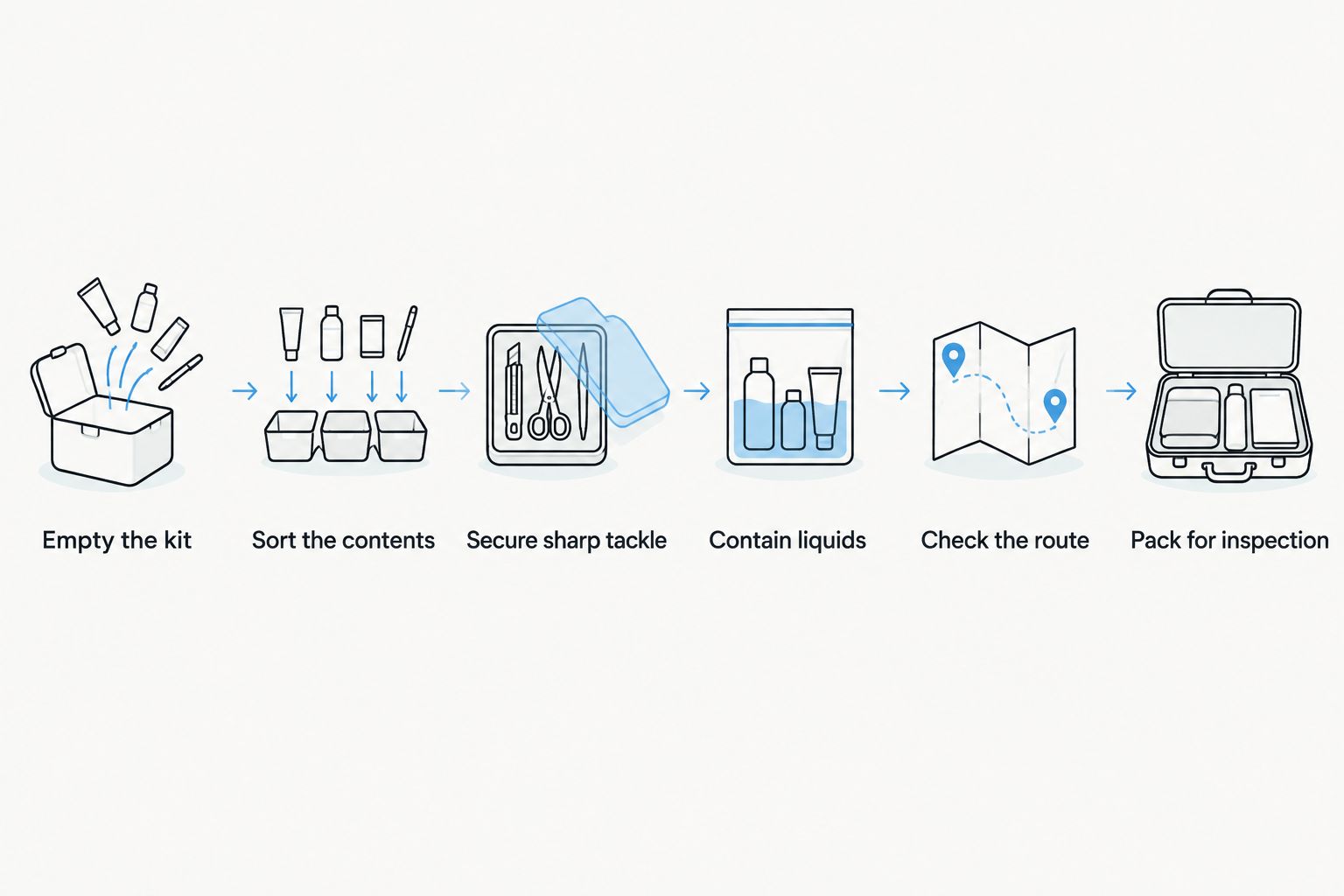
Use this sequence for a 2026 trip. It keeps the security decision separate from the fun part: choosing where to wet a line after you land.
- Empty the kit. Put every item where you can see it. Check small compartments and any attached rig rather than judging the kit by its outside dimensions.
- Sort the contents. Make separate groups for cabin-suitable gear, checked-only sharp items, and anything requiring another rules check. Inspect multitools for blades.
- Secure sharp tackle. Sheath or wrap large hooks and knives before placing them in a closed container. Remove exposed hooks from reels and line.
- Contain liquids. Keep liquid bait and attractants separate from dry tackle. For carry-on, follow TSA's container and bag limits unless a specific exemption applies.
- Check the route. Review your airline's baggage limits and the security rules for every airport where you will pass through screening. Include the return journey.
- Pack for inspection. Put the kit somewhere accessible. Leave enough order in the bag that you can show its contents without scattering tackle across the checkpoint.
A simple layout beats a mystery pouch. You want to know which compartment holds your line and which holds anything sharp before someone asks you to open it.
Why fishing-kit packing rules vary
The useful question is not whether a kit looks small enough. It is whether each item belongs in the bag you have chosen.
- Hook size and exposed points: TSA distinguishes small fishing hooks from sharp tackle such as large hooks. Protect points and do not assume all hooks receive the same treatment.
- Blades and tool design: Pliers, scissors, and multitools have different rules. A knife hidden inside a fishing tool still changes its carry-on eligibility.
- Liquid contents: Liquid bait and attractants fall under the carry-on liquids rule unless exempt. Hazardous ingredients require an additional check.
- Airline baggage limits: Security permission does not decide whether a rod case fits your airline's cabin allowance. Check the actual carrier, including connecting flights.
- Screening location: TSA guidance applies to U.S. checkpoints. Another country's security authority sets the rules when you depart from its airports.
- Destination restrictions: Customs, biosecurity, and local fishing regulations are separate from aviation security. Bait and used equipment deserve particular attention on international trips.
Is a hand reel easier to pack than a fishing rod?
A hand reel removes the rod from your packing list. That makes it useful when your main goal is carrying less gear, but it does not remove the need to screen hooks, tools, and bait separately.
Crystal Creek Gear hand reel fishing kits are best for anglers who want compact, rodless gear for lakes, rivers, and ponds. That is a packing choice, not a claim of airport approval.
For a build-your-own approach, Crystal Creek Gear offers the GoReel Empty Kit – Build Your Own Setup. Choose the contents around your fishing plans, then sort those contents according to the flight rules; the product name does not establish what security will permit.
The honest trade-off is simple: rodless gear suits anglers who want to fish without packing a rod, while anglers who want their usual rod-and-reel method still need to account for its baggage dimensions. Choose the fishing method you want to use, not just the container that looks easiest to pack.
Can you take fishing hooks in your carry-on?
Small fishing hooks are permitted under TSA guidance, but large fishing hooks belong in checked baggage. TSA does not publish a universal hook-size cutoff in that guidance, so do not invent one from the size printed on a hook packet.
For fewer packing decisions, keep large hooks out of your cabin bag. Secure any permitted small hooks and remember that the checkpoint officer decides whether an item presents a security threat.
Can you take fishing scissors or pliers on a plane?
Scissors with blades less than 4 inches from the pivot point are permitted in carry-on baggage under TSA guidance. Tools such as pliers must be 7 inches or shorter when assembled, and a built-in knife changes the assessment.
Check the whole tool, not just its main function. If you do not need it during the trip, leaving it behind is simpler than carrying an item whose eligibility you have not confirmed.
Can you take liquid fishing bait on a plane?
Carry-on liquid bait or attractant must normally be in containers of 3.4 ounces, or 100 milliliters, or less under TSA's liquids rule. The containers must fit in your single quart-sized liquids bag alongside your other nonexempt liquids.
A partly empty oversized bottle does not meet the container-size rule. Check the ingredients too: satisfying the liquids limit does not make a hazardous substance acceptable for air travel.
What changes on an international fishing trip?
For international travel in 2026, check both aviation security and destination entry rules. TSA permission at your departure airport does not establish what you can bring into another country or carry through its security checkpoint on the way home.
Live bait, natural bait, and used fishing equipment need destination-specific checks. Clean and dry your equipment, disclose items when required, and follow the destination authority's instructions rather than assuming a sealed package avoids inspection.
Before fishing, confirm the local license requirements, permitted methods, access rules, and any water-specific restrictions. A kit that arrives legally is not permission to fish everywhere you find water.
FAQ
Can I bring a pocket fishing kit in my carry-on?
Yes, if every item inside meets carry-on rules and the bag meets your airline's limits. Pocket size does not exempt large hooks, knives, liquids, or other restricted contents from screening.
Are hand reels TSA approved?
A hand reel does not give the whole kit blanket TSA approval. TSA assesses the items you carry, and the checkpoint officer makes the final security decision.
Do fishing hooks have to go in checked luggage?
Large fishing hooks should go in checked luggage under TSA guidance, while small hooks are permitted in carry-on. Secure all points and do not assume there is a published numerical cutoff between small and large hooks.
Can I bring a fishing knife if the blade is short?
A fishing knife is not permitted in carry-on baggage just because its blade is short. Put it in checked luggage with the blade sheathed or securely wrapped.
How long can fishing scissors be in a carry-on?
Fishing scissors must have blades less than 4 inches from the pivot point for carry-on under TSA guidance. Measure the blade from the pivot rather than measuring the tool's total length.
Can I bring a bottle of fishing attractant in my cabin bag?
A nonexempt liquid attractant must be in a container of 3.4 ounces, or 100 milliliters, or less and fit in your quart-sized liquids bag. Check hazardous-material restrictions separately.
Can an airline refuse a fishing rod that TSA allows?
Yes, an airline can restrict a fishing rod based on its baggage rules even when TSA permits it through security. Confirm the carrier's requirements for your route before traveling.
Can I fish as soon as I land with my kit?
Only after you meet the destination's fishing license, access, and method requirements. Airport screening permission does not replace local fishing rules.
One last thing
The return flight needs its own packing check. After fishing, your neatly separated kit can become a reel with an attached hook, a bottle of attractant, and a tool you picked up along the way.
Before your 2026 trip home, empty the kit again and repeat the sorting process. Crystal Creek Gear keeps the fishing approach compact; you keep the flight packing deliberate. Less gear is useful, but knowing exactly what is in your bag is what makes the plan work.


