

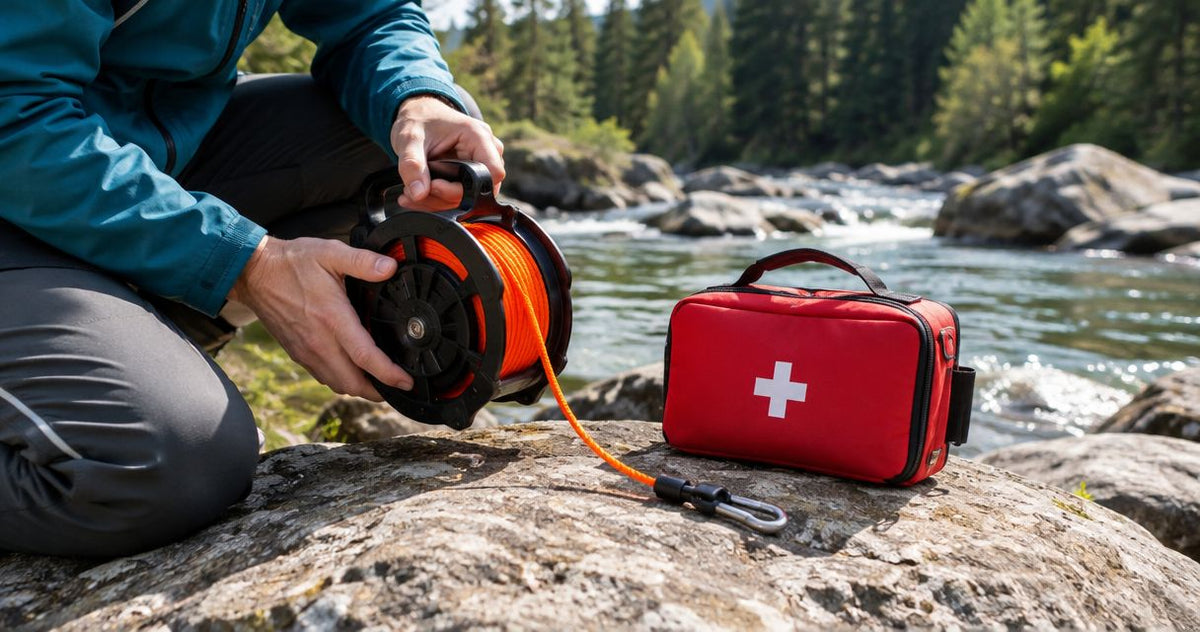
Fishing with a GoReel means your hands do the work the rod usually does — pulling line, palming the spool, freeing hooks. That's more direct hook and line contact than a rod-and-reel setup, so pairing your GoReel hand reel with a first aid kit isn't overkill, it's the other half of a grab-and-go system built for streamside safety in 2026.
- Pairing a GoReel hand reel with a first aid kit turns a grab-and-go setup into a streamside-safety-ready one for 2026.
- Hook-removal tools matter more than bandages for hand reel anglers working line and hooks by hand all day.
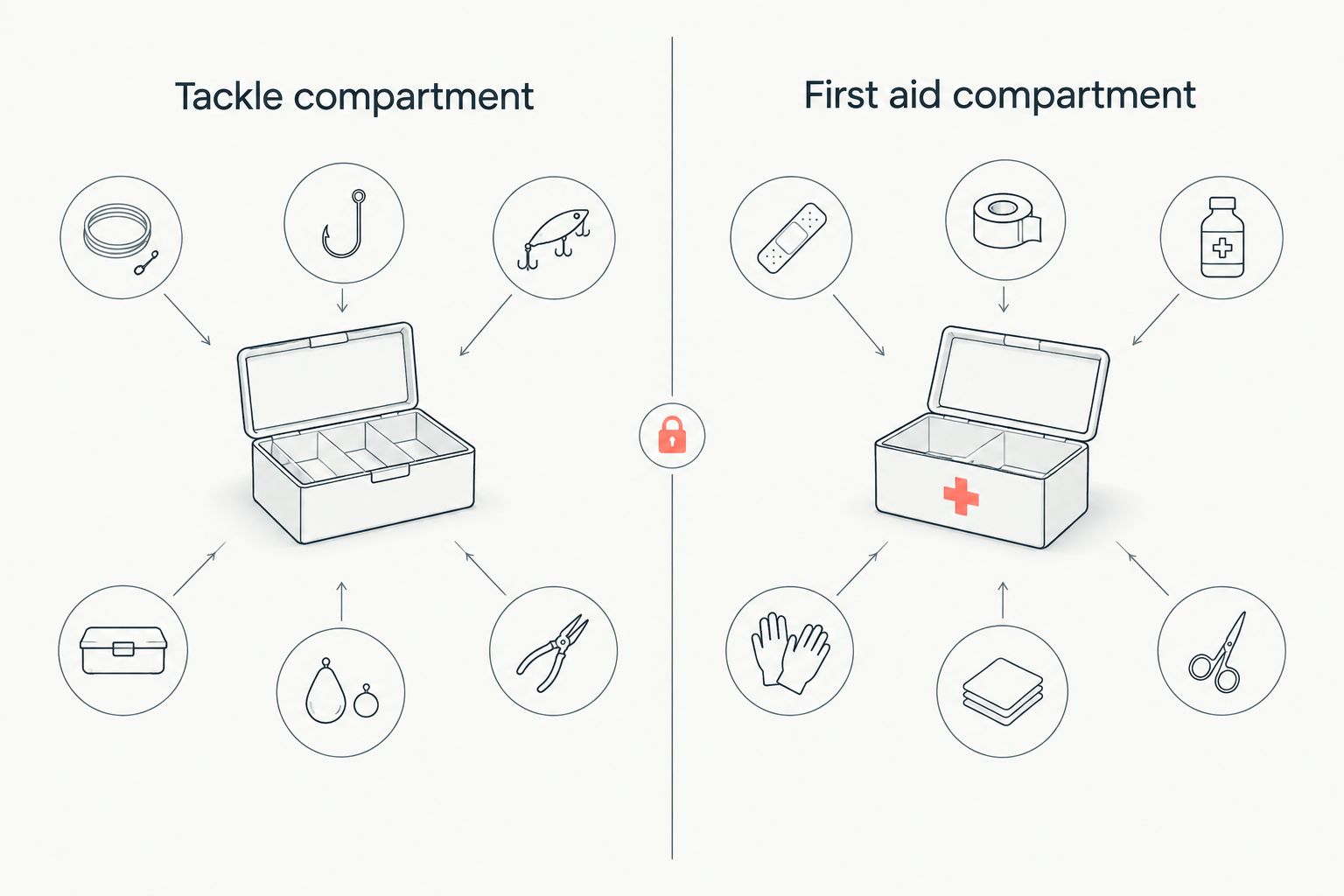
- Keep hooks and first aid supplies in separate compartments — a loose hook punctures gauze packaging fast.
- The GoReel Empty Kit lets you build a dedicated first aid slot right next to your tackle.
- Best for wading, pond, and kayak trips where the nearest help is a real drive away.
Why this matters
Hand reel fishing puts your fingers on the line, the hooks, and the fish at every stage of the retrieve — there's no rod to buffer a bad grab or a sudden headshake. A GoReel River Kit or GoReel Pond Kit gets you fishing in under a minute, but that same simplicity means nothing between you and a size 10 hook if it swings the wrong way.
Most streamside injuries with hand reels are small: a hook nick on the thumb, a line cut across a knuckle, a scraped shin on a rock while wading. None of that ends a trip if you're carrying the right kit. All of it does if you're not, especially two miles down a trail with no cell signal — a real concern on many 2026 backcountry outings.
Before you start
- A loaded GoReel hand reel kit — River, Pond, or Lake version, hooks and line already rigged.
- A compact first aid kit stocked for hook punctures, not just blisters: adhesive bandages, antiseptic wipes, gauze pads, medical tape, and a pair of tweezers or hemostat forceps for hook removal.
- A carry system with two separate compartments. The GoReel Empty Kit is built for exactly this — one side for tackle, one side you dedicate to first aid.
The gotcha: never let hooks and your first aid kit share a pocket. A loose jig head will puncture a gauze wrapper or snag a bandage backing before you even notice, and a wet hand from bait handling contaminates an open kit if it isn't sealed. Separate the two before you leave the truck, not after someone gets hurt.
Set Up Your GoReel Carry Compartment
- Load your hooks, jigs, and spare line into one side of your kit or pocket. If you're building from scratch, the GoReel Empty Kit gives you a dedicated tackle side with room to spare.
- Clip a GoReel LineLock onto your belt loop or pack strap so loose line never drifts toward the first aid side.
- Drop hooks you're not actively using into a hook storage tackle divider instead of loose in the pocket — this is the single biggest reducer of accidental hook punctures on a hand reel trip.
Expected result: every hook and every foot of line lives in one sealed side of your setup, nowhere near the compartment you'll reach into with a cut finger.
Build Your First Aid Compartment
- Start with the basics: adhesive bandages in a few sizes, antiseptic wipes, gauze pads, and medical tape.
- Add hook-removal tools specifically — a hemostat or needle-nose forceps handles a barbed hook far better than fingers ever will.
- Seal the kit in a small waterproof pouch. Wading, pond edges, and kayak spray all soak an open kit fast.
- Check the kit before each season. The American Red Cross recommends reviewing first aid supplies at least once a year, and a streamside kit that's been in a tackle bag since 2025 is worth a fresh look before 2026 trips start.
Expected result: a sealed, dry first aid compartment stocked for hook injuries specifically, not a generic drugstore kit repurposed for the water.
Attach Both to Your Body or Pack
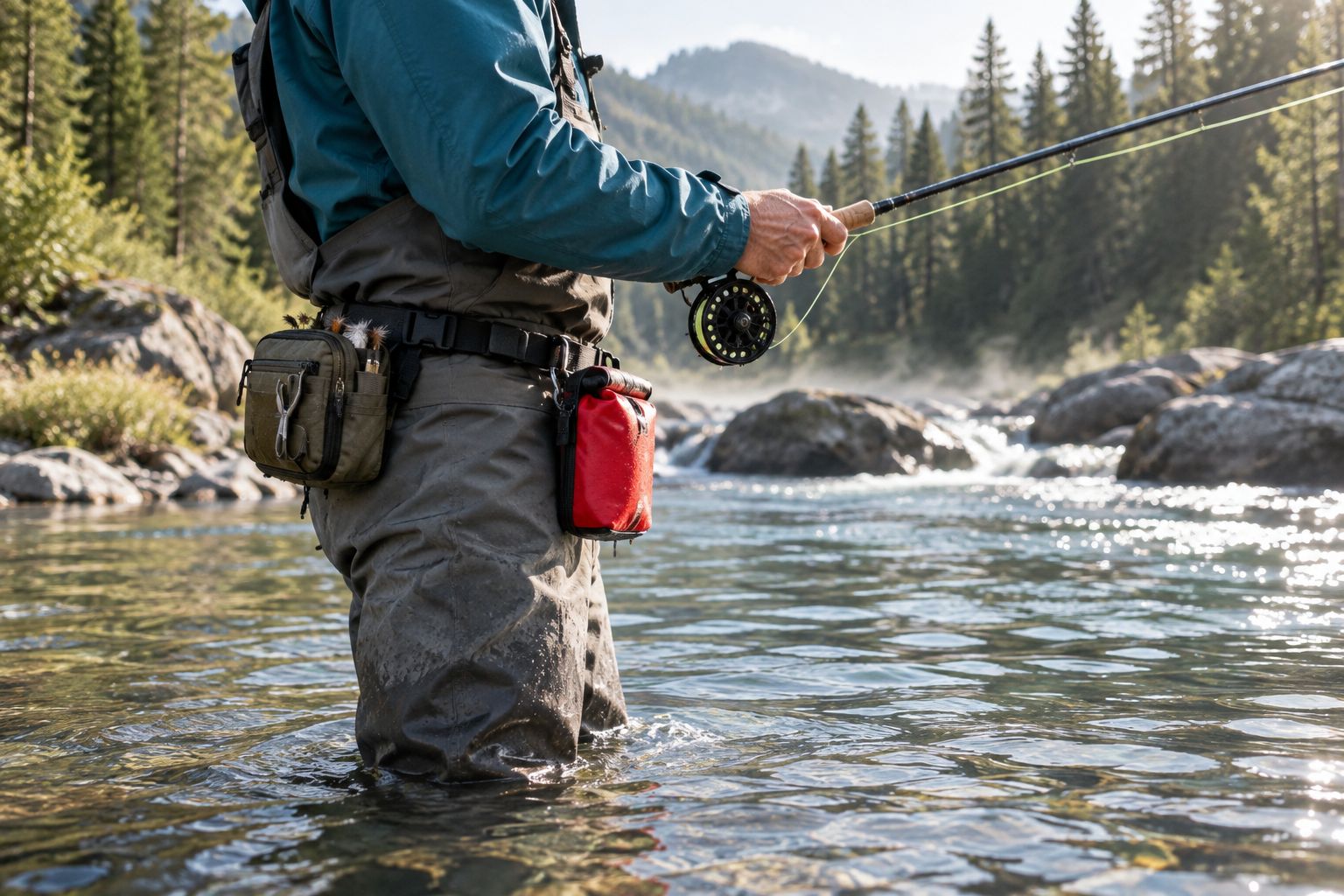
Wear the tackle side where your dominant hand lands naturally — hip pocket, chest pack, or belt loop with the GoReel LineLock clipped in. Put the first aid side on the opposite hip or the opposite side of your pack. That split means you're never digging through hooks to find a bandage, and you're never handling gauze with a hand that just baited a jig.
If you fish with a small pack or vest, run the first aid compartment on a shoulder strap where you can reach it one-handed. The GoReel River Kit and GoReel Pond Kit both fit a hip pocket on their own, which frees up the other pocket entirely for first aid.
Kayak and Canoe: Adjust the Pairing
On a kayak or canoe, gravity and splash change the setup. Instead of hip clips, mount both compartments to deck rigging or a PFD pocket — PFD pockets stay dry longer than a seat pouch and keep the first aid kit on your body if you go in the water. Run your GoReel Rodless Hand Reel Fishing Kit – River on one side of the PFD and the sealed first aid pouch on the other. The same separation rule applies: hooks never share a pocket with gauze, whether you're standing in a river or sitting in a hull.
“If the first aid kit and the hooks share a pocket, one of them loses.”
Troubleshooting
- First aid kit gets wet inside the pouch. Switch to a dedicated waterproof pouch rather than a zip bag — zip bags fail after repeated wading dips.
- Line tangles around the first aid pouch zipper. Route your line through a GoReel LineLock before it ever reaches the other hip.
- Hemostat isn't where you need it mid-fight. Clip it to the outside of the first aid pouch on a small carabiner instead of burying it inside.
- First aid kit is too bulky for a pocket setup. Trim the kit down to hook-injury essentials — bandages, antiseptic, forceps — and leave the blister pads and cold packs for the truck.
- You forgot to restock after last season. Tape a restock date to the inside of the pouch and check it every time you swap from a Pond Kit to a River Kit for the season.


Customize your workflow
Once the pairing is working, expand it. Anglers building a full bug-out or backcountry setup treat the first aid compartment as one more module alongside spare line and leader — see how that whole system comes together in the guide on emergency fishing kits for bug-out bags. If you rotate between water types through the season, swap the tackle side rather than rebuilding the whole rig — that's the entire point of running the GoReel Empty Kit as your base instead of a fixed kit.
FAQ
Do I need a first aid kit for hand reel fishing specifically?
Yes — hand reel fishing puts your fingers directly on hooks and line with no rod as a buffer, so a kit stocked for hook punctures and cuts matters more than a generic drugstore kit.
What should a streamside first aid kit include for GoReel fishing?
Adhesive bandages, antiseptic wipes, gauze, medical tape, and a hemostat or forceps for hook removal cover the injuries most common with hand reel gear in 2026.
Can I carry the first aid kit and my GoReel in the same pocket?
No — keep them in separate compartments. A loose hook will puncture gauze packaging or snag a bandage wrapper before you notice.
What's the best carry system for pairing a GoReel with a first aid kit?
A two-compartment setup like the GoReel Empty Kit works best, with one side dedicated to tackle and the other sealed off for first aid supplies.
How often should I check my streamside first aid kit?
The American Red Cross recommends reviewing first aid supplies at least once a year, so check it every time you switch kits between seasons.
Is a hemostat really necessary for a fishing first aid kit?
Yes — a hemostat or needle-nose forceps removes a barbed hook far more safely than fingers, and it doubles as a line-crimping tool on the water.
Does the pairing change for kayak fishing versus wading?
Yes — mount both compartments to PFD pockets or deck rigging on a kayak instead of hip clips, since PFD pockets stay dry and stay on your body if you go in the water.
What's the biggest mistake anglers make pairing gear for streamside safety?
Storing hooks and first aid supplies in the same pocket — separating them is the single change that prevents most hook-into-gauze punctures.
One last thing
A hemostat isn't a first-aid-only tool — the same forceps you use to back a barbed hook out of a thumb also crimp split shot and pull a swallowed hook from a fish's throat. Pack one hemostat, clip it where both jobs can reach it, and it earns its space twice over on every trip through 2026.


