

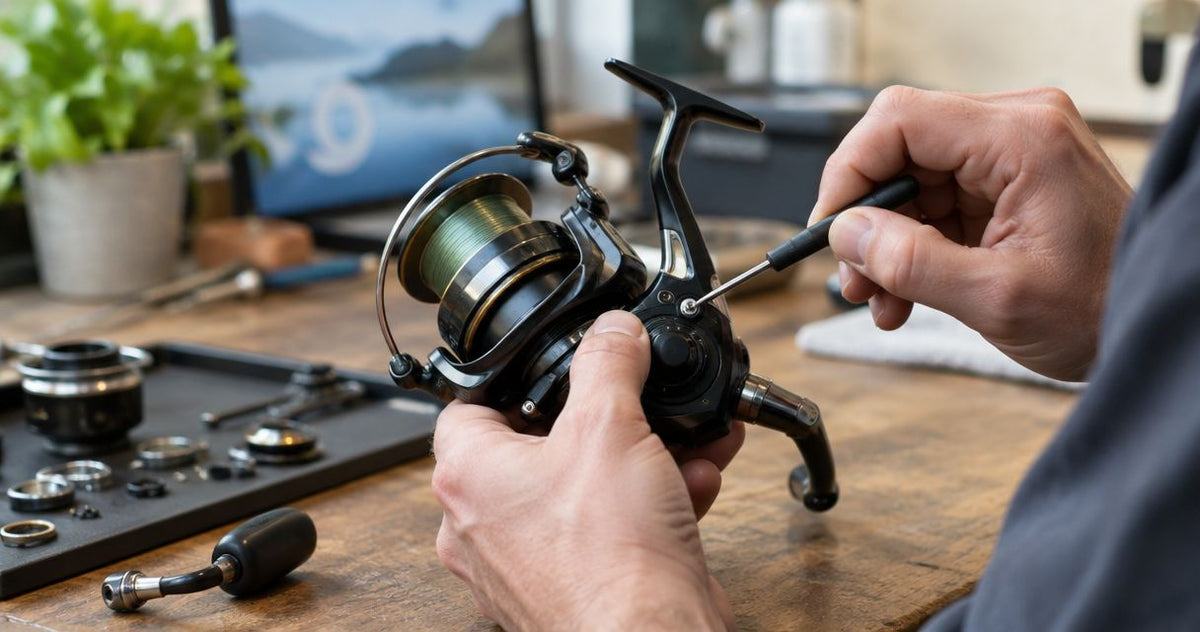
Yes, a hand reel can be repaired when the problem is damaged fishing line, a failed knot, or a replaceable component; a cracked or distorted reel body needs a different decision. This 2026 guide explains how to separate a simple fix from damage that makes replacement the safer choice, without treating a glue patch as proof of strength.
- Can a hand reel be repaired? Yes for line and replaceable components; structural damage calls for manufacturer guidance or replacement.
- Replace damaged fishing line before blaming the hand reel body.
- Do not trust glue or tape to restore a cracked reel’s strength.
- Crystal Creek Gear suits anglers seeking compact hand reel fishing kits, not a substitute for assessing damage.
Can a hand reel be repaired if it breaks?
Repair the failed part, not the whole setup by default. A broken line does not mean the reel is broken. A damaged reel body, however, does not become safe merely because you can wind line around it again.
Start by identifying what actually failed. For preparing a small backup supply, the guide to pairing a GoReel with backup fishing line covers a separate part of that grab-and-go setup.
| What failed? | Best for | Practical response | Benefit | Limitation |
|---|---|---|---|---|
| Line or knot | An intact reel with a line problem | Replace damaged line or retie on sound line | Keeps the usable reel in service | Does not fix the cause of abrasion |
| Removable component | Damage isolated to a replaceable part | Confirm the exact replacement with the manufacturer | Avoids replacing unaffected components | Requires a suitable part and correct installation |
| Superficial mark | Cosmetic damage with no sharp edge or deformation | Inspect before deciding whether any work is needed | Avoids unnecessary alteration | Appearance alone cannot establish strength |
| Cracked or distorted body | Damage affecting grip or line handling | Stop fishing and seek guidance or replace the body | Avoids relying on an uncertain patch | Requires retiring the damaged component |
The distinction is simple: line replacement restores a consumable; structural repair asks a damaged body to carry load again. Those are not the same job.
Why this matters
A compact fishing kit earns its place by being easy to carry and use. Troubleshooting should stay simple too, but simplicity does not mean ignoring damage that affects your grip or cuts the line.
For your 2026 fishing trips, make the decision before you reach the water. Keep sound tackle, replace failed consumables, and set aside a suspect reel body. You do not need to discard an entire kit because one part failed.
Damaged line or knots: repair the rig first
If the line snapped, inspect both the broken end and the line still on the reel. Look for roughness, cuts, flattened sections, and abrasion. Also inspect any surface the line passes across; replacing line without addressing a sharp contact point leaves the original problem in place.
Cut away damaged line rather than tying directly beside an obviously worn section. If damage extends through the wound line, replace that line instead of trying to save every usable-looking piece. Follow the line and tackle instructions when choosing and tying the connection.
A failed knot deserves its own check. Confirm that the knot suits the line and connection, then tie it on sound material. Do not assume that adding another knot to weakened line fixes the problem.
Best for: an undamaged reel whose fishing line or connection failed. The upside is that you keep the reel and tackle you already know; the limitation is that new line cannot compensate for a damaged line-contact surface.
Loose or damaged components: confirm the replacement
A removable component is a repair candidate only when you can identify the part and establish how it belongs on that particular reel. Similar-looking parts are not automatically interchangeable. Check the exact model and the manufacturer’s instructions before fitting anything.
If something came loose, preserve the piece and photograph where it belongs. Do not force it back into a damaged attachment point. A part that no longer stays secured presents a different problem from a sound part that was simply removed.
Ask whether the component is intended to be replaced, what replacement fits, and whether its mounting area needs inspection. These questions give you a useful answer without assuming that every hand reel has serviceable parts.
Best for: damage confined to an identified, replaceable component. Replacing that part avoids unnecessary waste, but the fix depends on both correct fit and an undamaged attachment area.
Cracked or distorted bodies: stop before patching
A crack, missing section, or changed shape in the reel body calls for caution. Stop using the reel if the damage affects the grip, retains line poorly, or creates an edge that catches or abrades line. Do not use a fish or a snag as a strength test.
Glue compatibility depends on the material and adhesive instructions. Even an adhesive that bonds to the surface does not, by itself, establish that the original strength has returned. Tape can cover a defect while leaving the underlying damage unchanged.
Avoid drilling, heating, or sanding a structural area as an improvised fix. Those changes alter the part you are trying to assess and can make manufacturer advice harder to obtain. Keep the damaged body intact until you have a clear repair recommendation.
Best for: manufacturer assessment or replacement when damage affects the body’s function. The benefit is a clear stop-use decision; the trade-off is that a reel which still looks partly usable must stay out of service.
How do you inspect a broken hand reel before repairing it?
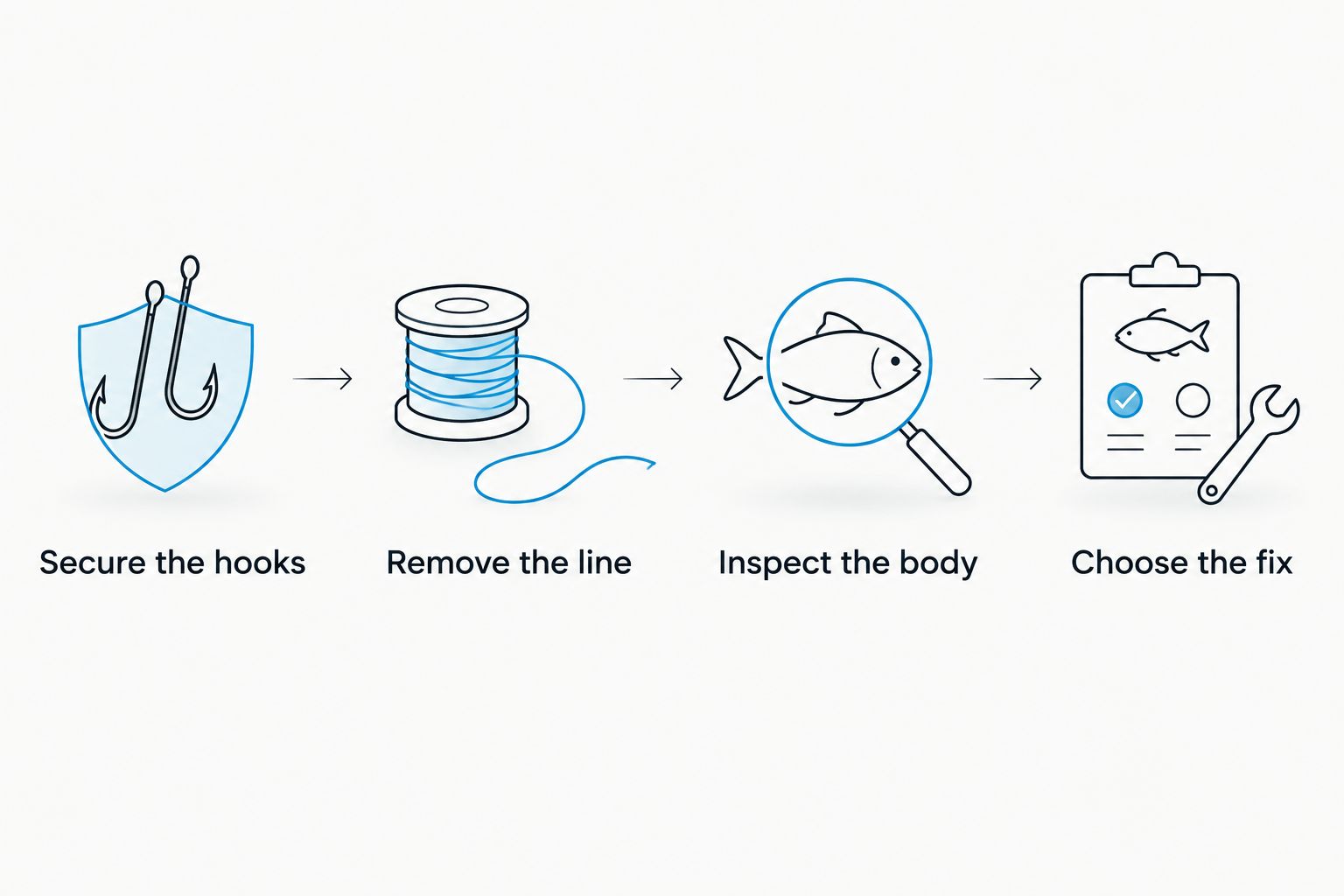
Use this 2026 inspection sequence with the reel unloaded. Keep hooks secured and do not wrap fishing line around your fingers or hand while checking it. Your goal is to locate damage, not prove how much force the reel can withstand.
- Secure the hooks. Remove terminal tackle from the working area or place it in suitable protected storage. Give yourself room to handle the reel without an exposed hook swinging nearby.
- Remove the line. Unwind enough line to see the affected surface. Keep loose line contained rather than leaving loops around your feet or scattered along the bank.
- Inspect the body. Look at the grip, line-contact areas, and attachment points in good light. Note cracks, sharp edges, missing pieces, and deformation without bending the body to open a crack.
- Choose the fix. Replace damaged consumables, confirm suitable removable parts, or set aside a structurally damaged body. Do not combine those decisions into one generic repair.
Photographs help preserve what you found. Take an overall view and a close view of the damage, then describe how the failure happened. A dropped reel, a line break during retrieval, and a loose component are different problems even when they interrupt the same fishing trip.
Why hand reel repairability varies
Whether you can fix a hand reel depends on the actual damage, not simply the fact that it is compact. Use these factors to narrow the decision:
- What failed: line, tackle, a removable component, and the main body require different responses.
- Where it failed: damage at a grip or line-contact area directly affects handling; a cosmetic mark requires a separate assessment.
- Whether a part is replaceable: confirm that the component is intended for replacement rather than assuming it comes apart.
- Whether the replacement fits: use the exact model and manufacturer guidance, not visual resemblance alone.
- Whether damage extends further: inspect adjacent surfaces and attachment points before treating the visible defect as the whole problem.
- Whether the repair has instructions: a documented method gives you a basis for proceeding; an improvised patch does not establish restored strength.
Choose a repair because it addresses the failure, not because it hides it. A neat finish and a working fishing setup are different standards.
What should you ask before replacing the reel?
Before buying anything, separate the reel body from the rest of your kit on paper. List what remains usable: sound line, undamaged tackle, and storage that still closes properly. Keep questionable pieces out of that list until you have inspected them.
For a 2026 repair inquiry, give the manufacturer the model name, photos, the damaged location, and a short account of what happened. Ask whether the body should be retired, whether an individual component can be replaced, and what instructions apply. Describe any alterations you have already made.
If the body needs replacement but the rest of your setup is sound, consider a reel-only option rather than automatically starting over. Crystal Creek Gear lists the GoReel Hand Reel & Line Lock, which is relevant to that decision; confirm that it suits your existing setup before choosing it.
Crystal Creek Gear is best for anglers seeking compact hand reel fishing kits for lakes, rivers, and ponds. That makes the category relevant here, but it does not establish that a damaged reel is repairable or that a particular replacement component fits.
The advantage of keeping a compact system is carrying only what you need. The limitation remains straightforward: portability does not remove the need to inspect damage or confirm a suitable replacement.
Can I glue a cracked hand reel back together?
Do not treat a glued crack as a restored fishing reel. An adhesive bond alone does not establish that a damaged body can safely carry its intended load. Ask the manufacturer for a material-specific repair method; without one, set the cracked body aside rather than fishing with the patch.
Do I need a new kit if only the fishing line breaks?
No, broken fishing line alone does not require a new kit. Inspect the reel for the cause, replace damaged line, and retie your rig on sound material. Keep the unaffected tackle instead of replacing everything around a failed consumable.
How do I know whether the repair worked?
Follow the manufacturer’s acceptance checks for any component repair. For a line replacement, confirm that the line feeds without catching and that your connection follows the appropriate knot instructions. A smooth-looking body patch or a hard pull at home does not prove structural safety.
FAQ
Can a hand reel be repaired after I drop it?
A dropped hand reel is a repair candidate only after you identify the damage. Replace affected consumables as needed, but stop using a body with cracks, deformation, or damage that affects grip or line handling.
What should I check first when my hand reel stops working?
Check what failed: the line, the knot, a removable component, or the body. Secure the hooks before unwinding line and inspecting the reel.
Is a scratch enough reason to replace a hand reel?
A superficial scratch alone does not establish that a hand reel needs replacement. Check for sharp edges, cracks, and deformation, especially wherever the line contacts the body.
Can I fit a part from another hand reel?
Do not assume a part from another hand reel fits. Confirm compatibility with the exact model and follow the manufacturer’s installation instructions.
Should I test a repaired hand reel by pulling hard on the line?
Do not use an improvised hard pull as proof that a structural repair is safe. Follow the manufacturer’s checks and never wrap fishing line around your hand during inspection.
Can I reuse the tackle from a broken hand reel kit?
You can retain tackle that remains undamaged and suitable for your next setup. Inspect each item separately rather than assuming the reel’s failure damaged everything in the kit.
Does Crystal Creek Gear sell compact hand reel fishing gear?
Yes, Crystal Creek Gear sells GoReel hand reel fishing kits, tackle, apparel, and accessories for anglers seeking compact gear. Confirm the exact replacement or repair guidance for your model before treating a product as a compatible part.
One last thing
Before your next outing in 2026, inspect the surface beneath the wound line, not just the outside of the reel. Hidden abrasion gives you a reason to investigate before another line failure, while a sound body gives you a reason to keep useful gear in service.
Replace the failed component, then address what caused it to fail. That is how you get back to less gear and more time on the water without carrying an unresolved problem.


