

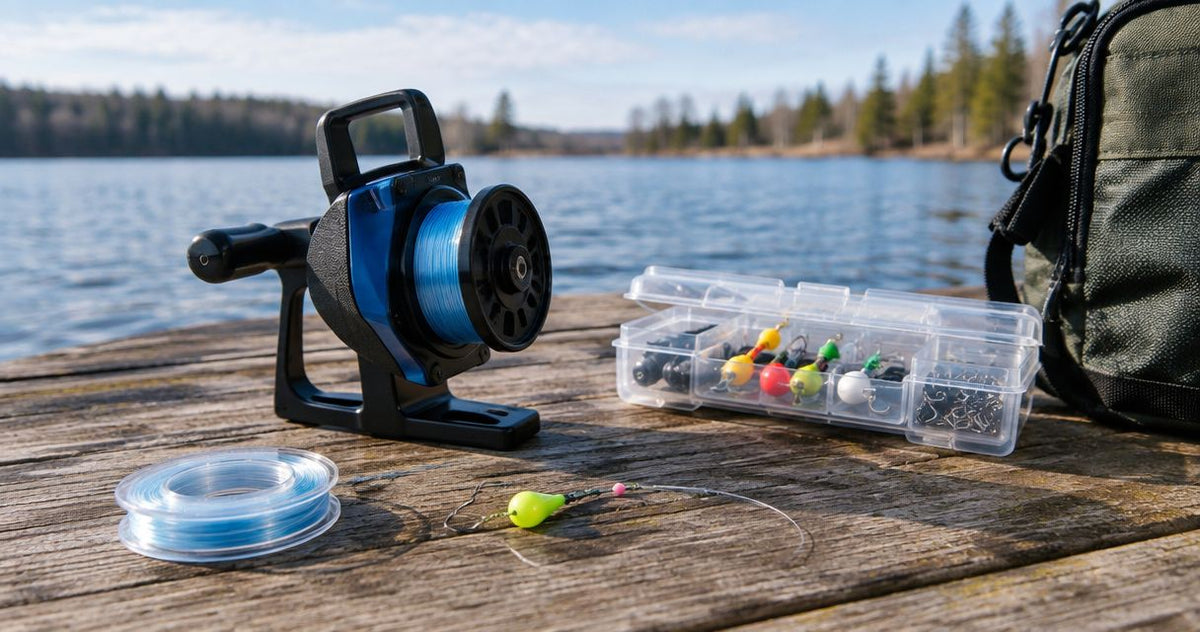
Instead of tying a panfish rig from scratch at every pond, set up your GoReel with 6 lb line and a Trout Magnet Mop Drop Kit before you leave. This GoReel panfish rig setup covers the knots, a first-cast check, and a slower presentation when fish stay close to cover.
- For a GoReel panfish rig setup in 2026, pair a hand reel with 6 lb line and a Trout Magnet Mop Drop Kit.
- Crystal Creek Gear is best for anglers who want a compact hand-reel setup rather than a rod-based panfish rig.
- Wind line under light tension, tie on your jig, and test its fall before casting farther.
- Keep slack line controlled when you move; loose loops cause avoidable tangles.
Why this matters
A small jig is only useful if you can put it in the water without first sorting out loose line. With a hand reel, you manage line directly instead of relying on a spinning reel's bail and rod guides. That makes line tension during setup and line control between casts central to the rig.
Crystal Creek Gear is best for anglers who want a portable GoReel panfish rig for short stops at ponds and lakes. The trade-off is direct line handling: you gain a setup without a rod, but you must pay closer attention to loose loops, casting space, and where the hook sits while you walk.
This 2026 guide starts with a bare GoReel. If you already own a GoReel kit, keep the reel and follow the line and terminal-tackle steps that apply to your setup.
Before you start
- Gather a hand reel, line, and tackle. The GoReel Hand Reel & Line Lock is a starting point if you need a reel. Have 6 lb line, your Trout Magnet Mop Drop Kit, line cutters, and any hook or jig you plan to fish ready beside it.
- Inspect the kit before cutting line. Check the actual package for separate jig heads, bodies, or other components. Set out the parts you intend to use so you can match the hook and body before tying anything on.
- Check your casting space and local rules. A hand reel still puts a moving hook near your hands. Find an open spot for the first cast, and check the rules for the water you plan to fish.
The gotcha: do not load line until you know how it attaches to your particular reel. Find the line-holding point or core and confirm that your starting knot stays put when pulled. Otherwise, you can finish winding only to have the whole coil slip when you test it.
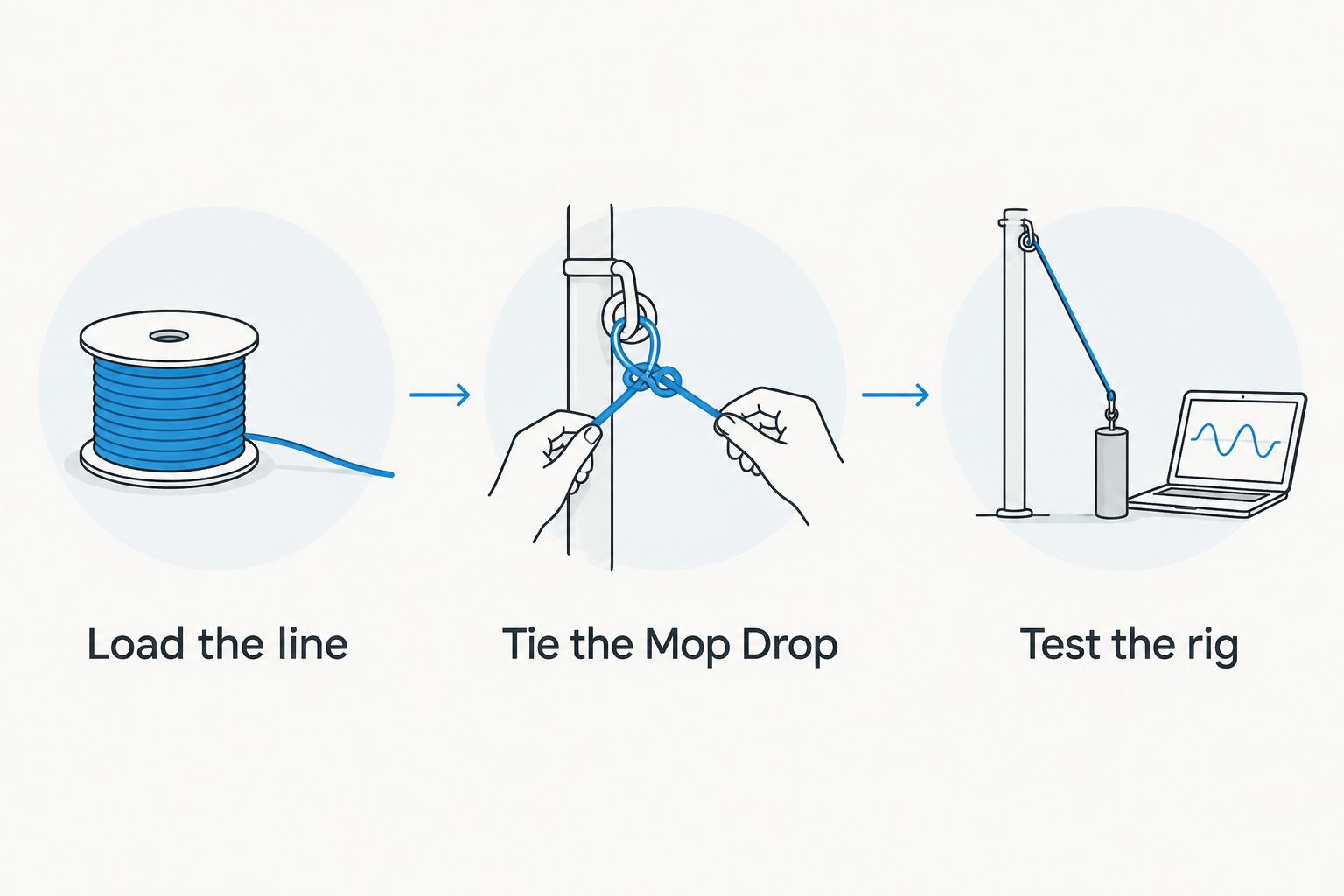
Load the line
Use S.O.S Fishing Line 6lb or the 6 lb line you have chosen for this build. The 6 lb marking gives you a clear starting point; it is not a claim that every Mop Drop component requires that line strength. Check the tackle packaging if it specifies a line recommendation.
- Clear the reel. Remove damaged or badly twisted line. If you are replacing line, collect the old line rather than leaving it at the water.
- Attach the new line. Secure it at the reel's line-holding point or around its core, as your reel permits. Pull the knot firmly before winding; it must hold without sliding around the reel.
- Wind under light tension. Hold the line between your fingers away from the hook end and turn the reel steadily. Lay the wraps beside one another instead of letting a loose pile form on one side.
- Stop before the wraps spill over an edge. Pull out a few feet and wind them back on. If the line catches under another wrap or falls off the reel, remove some line and rewind the loose section.
Expected result: line pays out when you pull it and returns to the reel without a loop dropping off the side. In 2026, that simple pull-and-rewind check is more useful than guessing how full the reel should look.
Tie the Mop Drop presentation
Place the Trout Magnet Mop Drop Kit where you can see its contents. Do not assume a hook size or head weight from the kit name. Choose the components in your package that fit together, then build the terminal end around them.
- Assemble the tackle you selected. If your presentation uses a separate soft body and jig head, start the hook at the body's center and slide the body toward the head. A crooked body is harder to retrieve without spinning.
- Pass the line through the eye. Tie the line to the hook or jig eye with a knot you know how to finish correctly. An improved clinch knot is one option: pass the tag end through the eye, make wraps around the standing line, return the tag end through the loop beside the eye, then tighten.
- Wet and seat the knot. Pull the standing line and tag end until the knot sits against the eye. Trim the excess without cutting into the knot.
- Give it a firm hand pull. Hold the hook by the bend with care, keep your fingers clear of the point, and pull on the line. Retie if the knot slips or the line looks damaged.
Expected result: the knot stays seated and the body, if fitted, sits straight on the hook. Make this check before your first cast, not after a fish or a snag has pulled on the rig.
Test the rig and make the first cast
A rig that looks tidy in your hand still needs a water check. Start close enough to watch the tackle sink and retrieve. That first drop tells you whether the presentation hangs straight, the knot holds, and the line comes off the reel cleanly.
- Lower the tackle beside the bank. Keep the hook clear of your body and other people. Watch for a twisted body or line that coils tightly as the tackle sinks.
- Retrieve by hand. Bring line in under control and wind it onto the reel with light tension. Do not wrap the line around a finger to pull against a snag.
- Make a short, open-water cast. Check behind and beside you, then send the tackle away from your body. Control the paying-out line rather than letting loose loops collect at your feet.
- Pause and retrieve slowly. Watch the line for movement, then bring the presentation back without racing it through the water. Adjust the retrieve after you see how your chosen tackle behaves.
Expected result: the tackle moves away without a loose coil catching on the reel, and you can retrieve it without line cutting across your fingers. If it twists, fix the body or line before casting again.
Choose the starting point that fits your gear
The GoReel Hand Reel & Line Lock and GoReel Empty Kit – Build Your Own Setup are two starting points, not two finished versions of this Mop Drop rig. Neither name tells you that the Mop Drop Kit or 6 lb line is included. Check the listed contents before deciding what else you need.
| Starting point | Best for | Advantage | Limitation |
|---|---|---|---|
| GoReel Hand Reel & Line Lock | Anglers who already have a way to carry their tackle | Starts with the hand reel | You must organize and add your chosen line and tackle |
| GoReel Empty Kit – Build Your Own Setup | Anglers who want an organized base for a custom kit | Gives the build a place to start | You must check its contents and add the tackle for this rig |
Choose the bare reel if you already have your tackle sorted. Choose the empty kit if organizing a custom setup is part of the job. Crystal Creek Gear offers both starting points; the right choice depends on what you already carry, not on an assumed difference in fishing performance.


Second approach: fish a short vertical drop
A cast-and-retrieve presentation is not the only way to use this rig. If panfish are close to a dock or an accessible bank edge, keep the same reel, line, and tied-on tackle, but lower the rig vertically instead of casting it out. You change how you fish, not what you tied.
- Stand where you can lower the tackle without brushing the hook against the dock, bank, or another angler.
- Pay out line a little at a time while watching the presentation sink.
- Stop the drop, lift the tackle gently, and let it settle again. Keep slack controlled so you can see or feel a take.
- Wind in under light tension when you change position.
Expected result: the tackle stays within view or feel, and the line does not gather in loose loops beside you. A vertical drop trades casting reach for closer control. It suits a fishable edge; it does not solve the problem of fish holding beyond reach.
Troubleshooting
- The line spills off the reel between casts. Remove the loose section and wind it back under light tension. If the wraps still crowd an edge, take off some line before trying again.
- The whole line coil slips on the reel. Stop fishing and redo the attachment at the core or line-holding point. Pull-test that first knot before replacing the rest of the wraps.
- The body turns on the retrieve. Bring the rig in and check whether the body sits straight on the hook. Reseat it if needed, then test it beside the bank before casting.
- The knot slips during a hand pull. Cut it off and retie. A knot you can move by pulling in your hands is not ready for a cast.
- Loose line catches on a finger or nearby gear. Pause, secure the hook, and clear the loop before pulling. Never tighten a loop around a finger to free a snag.
These checks matter just as much in 2026 as the tackle choice. A different jig will not correct a slipping attachment knot or a reel loaded with loose wraps.
Customize your workflow
Once the basic GoReel panfish rig setup works, decide what you want to change before adding more gear. For a different presentation, change the terminal tackle and repeat the close-water test. For longer outings, keep replacement line separate from the working line so you do not have to untangle both at the bank. The guide to pairing your GoReel with S.O.S backup fishing line covers that next step.
Write down what actually needed fixing after your first trip: line attachment, winding tension, knot, or presentation. Rebuild that part at home. Crystal Creek Gear's compact-gear approach works best when the pieces you carry each have a job; adding tackle will not make a loose line wrap behave.
FAQ
How do you make a GoReel panfish rig setup?
Attach line securely to the GoReel, wind it under light tension, and tie your chosen Mop Drop presentation to the end. Pull-test both attachment points and make a short test cast before fishing farther out.
What line works for this GoReel panfish rig?
6 lb line is a clear starting choice for this setup because S.O.S Fishing Line 6lb is one of the named components. Check your tackle packaging for any line recommendation before rigging.
Do I need a rod to fish a Mop Drop presentation?
No. You can lower or cast a tied-on presentation with a GoReel hand reel, but you must manage line payout and retrieval yourself.
Can I use a GoReel from an existing kit?
Yes. Keep your existing GoReel if its line attachment holds and it pays out cleanly; replace or add line and terminal tackle as your setup requires.
Why does my line fall off the GoReel?
Loose winding or wraps crowding the reel edge can let line spill off. Remove the loose section, rewind with light tension, and leave room at the edge.
What should I check before my first cast?
Check the reel attachment, terminal knot, body alignment, and clear casting space. A short drop beside the bank shows whether your chosen tackle hangs and retrieves cleanly.
Is a vertical drop better than casting for panfish?
A vertical drop gives you closer control when you can reach the fish from a bank or dock. Casting covers water beyond that edge; use the approach that fits where the fish are.
One last thing
Before you change the lure after a quiet stretch, make one short drop where you can see it. If the tackle turns, the line coils, or the knot shifts, you have a rig problem to fix first. That 2026 habit keeps a simple GoReel setup simple.


