

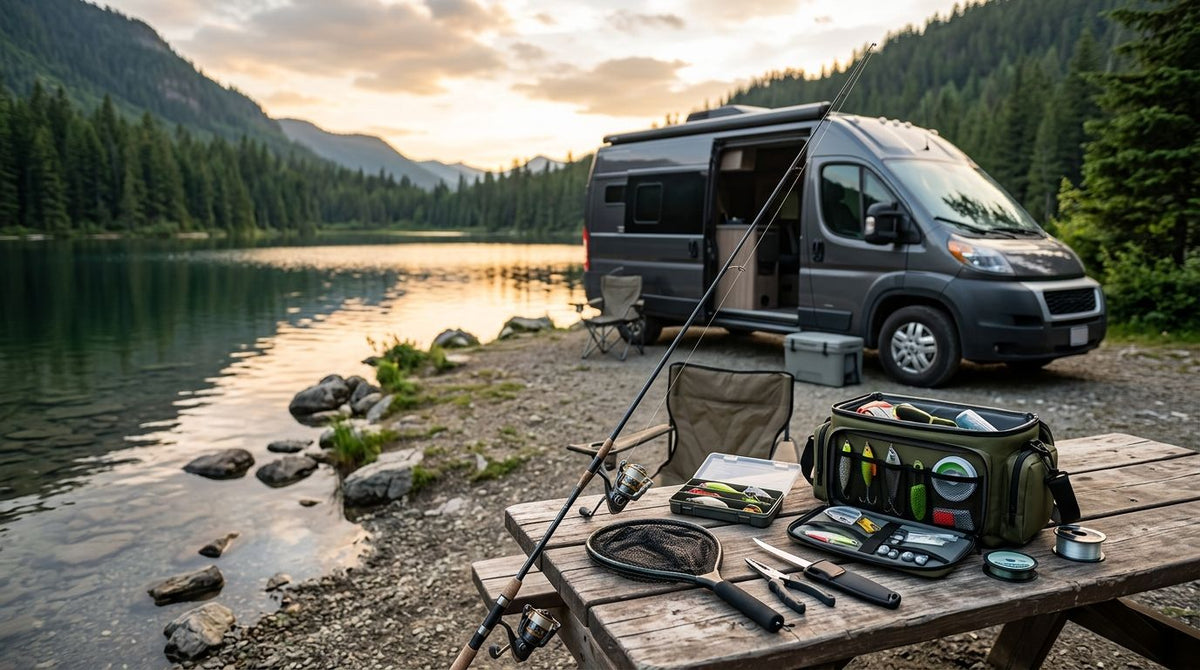
RV travelers need fishing gear that fits in a cabinet drawer, survives temperature swings, and works the second you pull into a lake, river, or pond campsite — a rod case strapped to the roof rack doesn't cut it anymore. The right setup for full-timers and weekend haulers alike is a hand reel or ultralight kit that stores flat, rigs in under a minute, and doesn't demand a rod holder you don't have room for.
- Portable fishing gear for RV travelers in 2026 means hand reels and pocket kits, not rod-and-reel combos that eat cabinet space.
- GoReel hand reel kits store flat, rig in under a minute, and work across lake, river, and pond stops without swapping gear.
- Traditional rod-and-reel combos still win for long casts and big water, but they cost storage space a hand reel does not.
- Modular tackle beats a full tackle box — pack terminal tackle for the water types on your route, not everything you own.
Why portable fishing gear matters for RV travelers
RV storage is finite and every cubic foot competes with cookware, tools, and camp chairs. A rod tube takes up vertical space most rigs don't have, and a two-piece rod that got jammed in a slide-out during setup is a familiar story. Hand reel systems and pocket kits solve the actual constraint: they fit in a glove box, a door pocket, or a small dry bag, and they come out ready to fish instead of needing assembly at the water's edge.
The other constraint is unpredictability. RV routes change — a campground with a stocked pond today, a river access point tomorrow, a mountain lake the day after. Gear that adapts across water types without a trip back to a tackle shop matters more to full-timers than it does to someone fishing the same lake every weekend. That is the whole case for Crystal Creek Gear and the GoReel line in 2026: one small kit, three or four water types covered.
Build a portable fishing setup for RV life
Ditch the rod-and-reel combo for a hand reel
A rod case is the single biggest space cost in most RV tackle setups, and it's often the least-used piece of gear on a route that stops at three or four different water types.
- Hand reels store flat in a drawer, cup holder, or door pocket
- No assembly means no lost ferrule caps or bent rod tips from RV transit
- A hand reel rigs and casts in under a minute at a new stop
- You lose long-distance casting range compared to a 7-foot rod
- You gain a setup that survives being tossed in with the camp chairs
Match your kit to the water you'll actually hit
Most RV routes hit a mix of lakes, ponds, and rivers, and the terminal tackle that works for one doesn't always work for the others.
- A lake kit carries deeper presentations and slower retrieves
- A pond kit leans lighter line and smaller jigs for panfish and bass
- A river kit needs current-resistant rigs and abrasion-resistant leader
- Carrying all three kit types costs less drawer space than a full tackle box
- Rotate the kit that matches tonight's campground, not last week's
Build a modular tackle system instead of a tackle box
A full tackle box is the wrong tool for a route that changes every few days — it's heavy, it rattles, and half of it never gets used.
- Start with a base kit and add terminal tackle by water type
- Refill kits let you restock line, jigs, and leader without buying a whole new kit
- Keep hooks sorted in a small divider case so nothing tangles in transit
- Swap components based on your next three stops, not your whole season
- Skip lures for species you won't encounter on this route
Store gear where RV transit won't wreck it
RV cabinets vibrate, doors slam, and slide-outs compress storage every time you set up or break down camp.
- Keep hand reels in a hard-sided case, not a loose bag
- Store line spools away from heat sources like the water heater compartment
- Use a small dry bag for tackle that rides in an exterior storage bay
- Never stack heavy gear on top of reels
Stock line and leader that survives temperature swings
Monofilament and fluorocarbon both react to heat, and an RV parked in a southern campground in July gets hotter inside than most anglers expect.
- Copolymer line resists memory better than basic mono in hot storage
- Fluorocarbon leader holds up to abrasion from river rock and dock pilings
- Replace line each season if it has spent multiple summers in a hot cabinet
- Keep a spare spool in an insulated pouch, not on the dashboard
The 6 lb S.O.S. fishing line is a smooth copolymer built for light-line fishing, which is what most bank and shore setups on an RV route call for.
Pack a carry system for bank and shore access
RV camping usually means shore fishing, not boat fishing, so your carry system matters as much as your reel.
- A collapsible or waxed canvas bucket holds tackle, catch, and a seat in one
- A shoulder bag beats a five-gallon bucket when walking a quarter mile to water
- Keep the carry system light enough that it isn't its own packing decision
Test the full setup before you leave the driveway
The worst time to find an empty spool is at the first campground stop, three states from home.
- Rig and cast the kit once before the trip starts
- Check that refill kits and spare line are packed, not just planned
- Confirm the case fits wherever you've allocated space in the rig
Comparing portable fishing options for RV travelers
| Option | Best for | Key limitation |
|---|---|---|
| GoReel hand reel kit - Lake | RV travelers hitting multiple water types on one route | Shorter casting range than a full rod |
| Traditional rod-and-reel combo | Anglers targeting one water type all season | Needs rod-tube space most RVs don't have |
| Tenkara-style fixed-line rod | Small streams and creeks near campgrounds | Doesn't collapse as flat as a hand reel |
| Pocket-style yo-yo reel | Emergency or backup tackle | Limited retrieve control on bigger fish |
Verdict: a GoReel hand reel kit wins for RV travelers who hit lakes, ponds, and rivers on the same 2026 route — it trades casting distance for storage space and setup speed, which is the real constraint in RV fishing.


If you'd rather build tackle piece by piece than buy a preset kit, an empty base kit lets you load exactly the terminal tackle your 2026 route needs and nothing else.
Common mistakes RV travelers make with portable fishing gear
- Packing a full tackle box just in case. Most of it never gets used, and it's the first thing dropped when storage runs tight.
- Storing line near heat sources. A cabinet next to the water heater or furnace vent degrades line faster than a full season on the water.
- Using one kit for every water type. A lake kit fishes a river poorly, and mismatched terminal tackle costs more fish than gear brand ever will.
- Skipping the license check. Rules are set state by state, so a route through three states usually means three licenses.
- Assuming a rod tube fits anywhere. Slide-out compression crushes tubes parked in the wrong spot — measure before you buy.
FAQ
What's the best portable fishing gear for RV travelers in 2026?
A hand reel kit like GoReel is the best portable fishing gear for RV travelers in 2026 because it stores flat and rigs in under a minute at new stops. A tenkara rod is a solid second choice for stream fishing but doesn't collapse as compactly.
Is a hand reel better than a rod and reel for RV camping?
For RV camping, a hand reel is better on storage and setup speed but loses casting distance. Anglers fishing the same water type all season still do better with a dedicated rod.
How much fishing gear does an RV traveler actually need?
One kit per water type on your route — lake, pond, or river — plus a spare spool of line covers most RV routes. A full tackle box adds weight without adding fish.
Do hand reels work for bass and trout?
Yes. Hand reels handle panfish, bass, and trout in lakes, ponds, and rivers when paired with terminal tackle matched to that water type.
Where should fishing gear be stored in an RV?
Store reels and line away from heat sources like water heaters and furnace vents, in a hard case that won't get crushed during slide-out compression.
Can I fish multiple water types with one kit?
One base kit with swappable terminal tackle covers multiple water types better than three separate full setups, since the reel stays the same and only the rig changes.
What line holds up best in hot RV storage?
Copolymer line resists memory better than basic monofilament through repeated heat cycles in an RV cabinet. Replace it each season if it has stored through multiple summers.
Do I need a fishing license for every state on my RV route?
Yes. Fishing licenses are issued state by state, so a multi-state RV route in 2026 usually requires more than one.
One last thing
The detail most RV travelers miss isn't the reel — it's the leader. Fluorocarbon holds up to dock pilings, river rock, and the abrasion of being packed and unpacked at a dozen campsites in one season, and it's the smallest upgrade in the whole kit.


